
Last updated September 20, 2026
Free on-site gate assessment - hinges, posts, and your LiftMaster or Nice gate operator checked before anything is quoted
The assessment is free and the quote is the invoice.
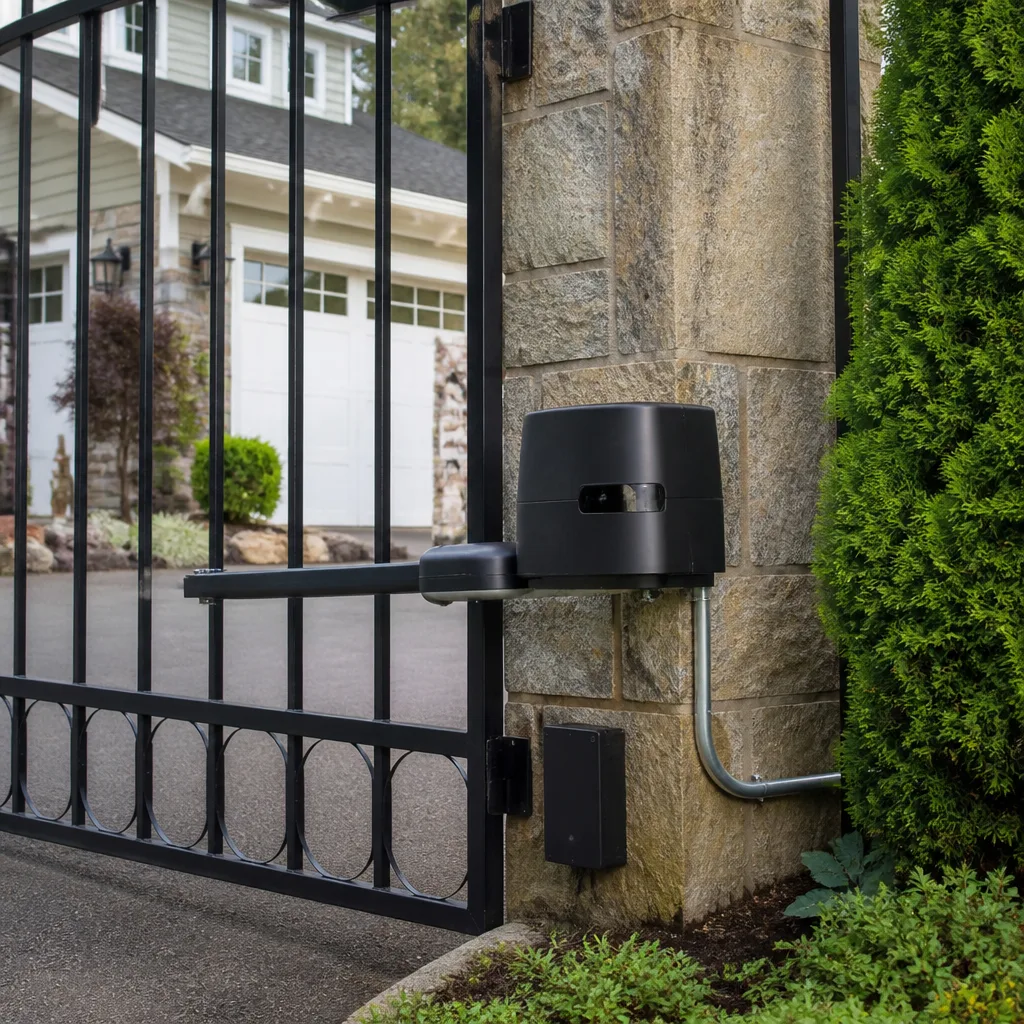
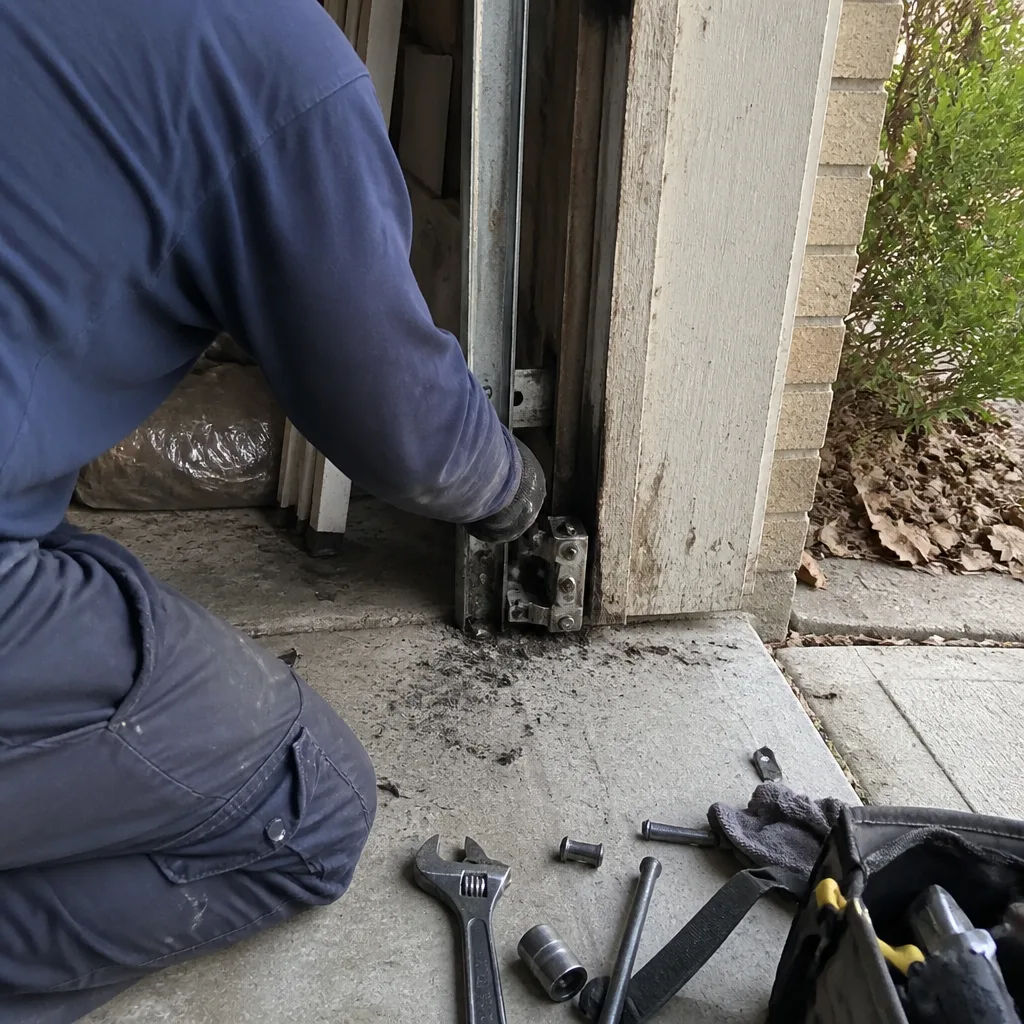 Before
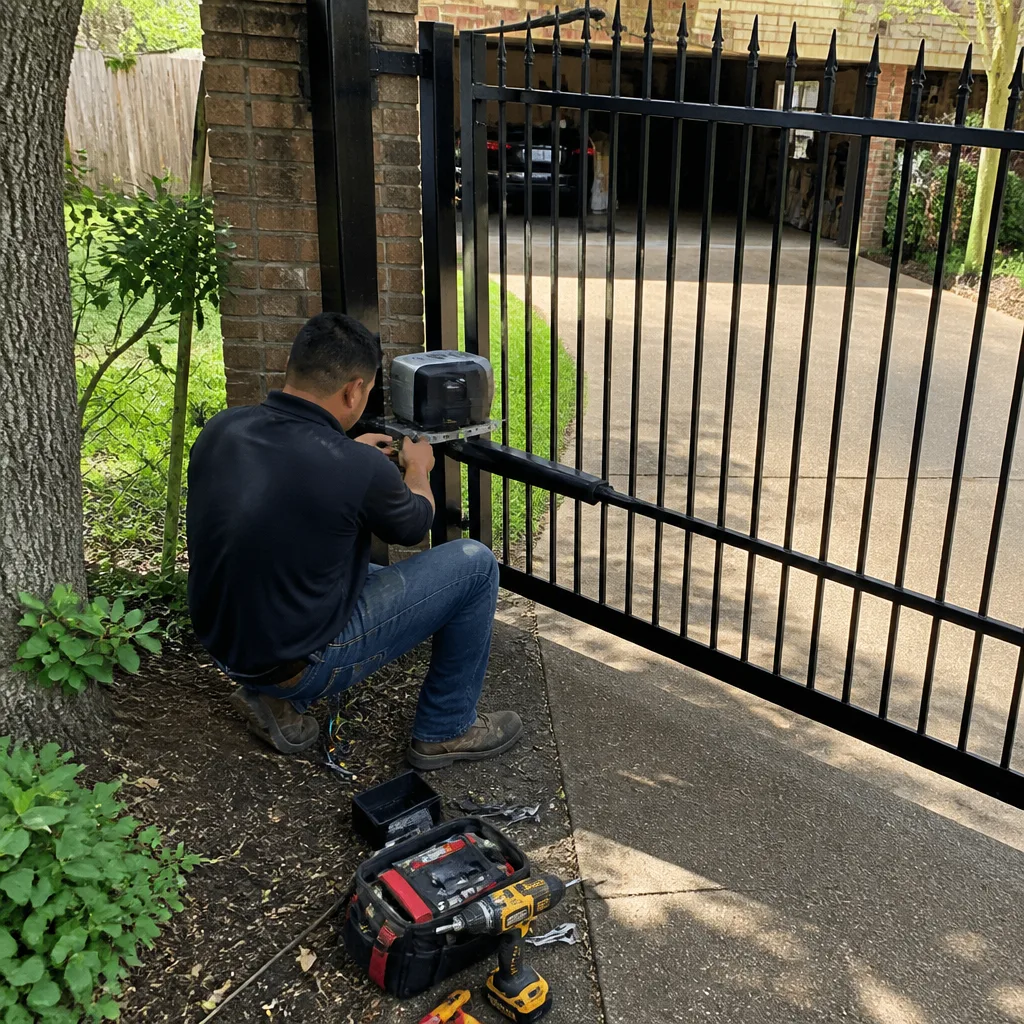 After
After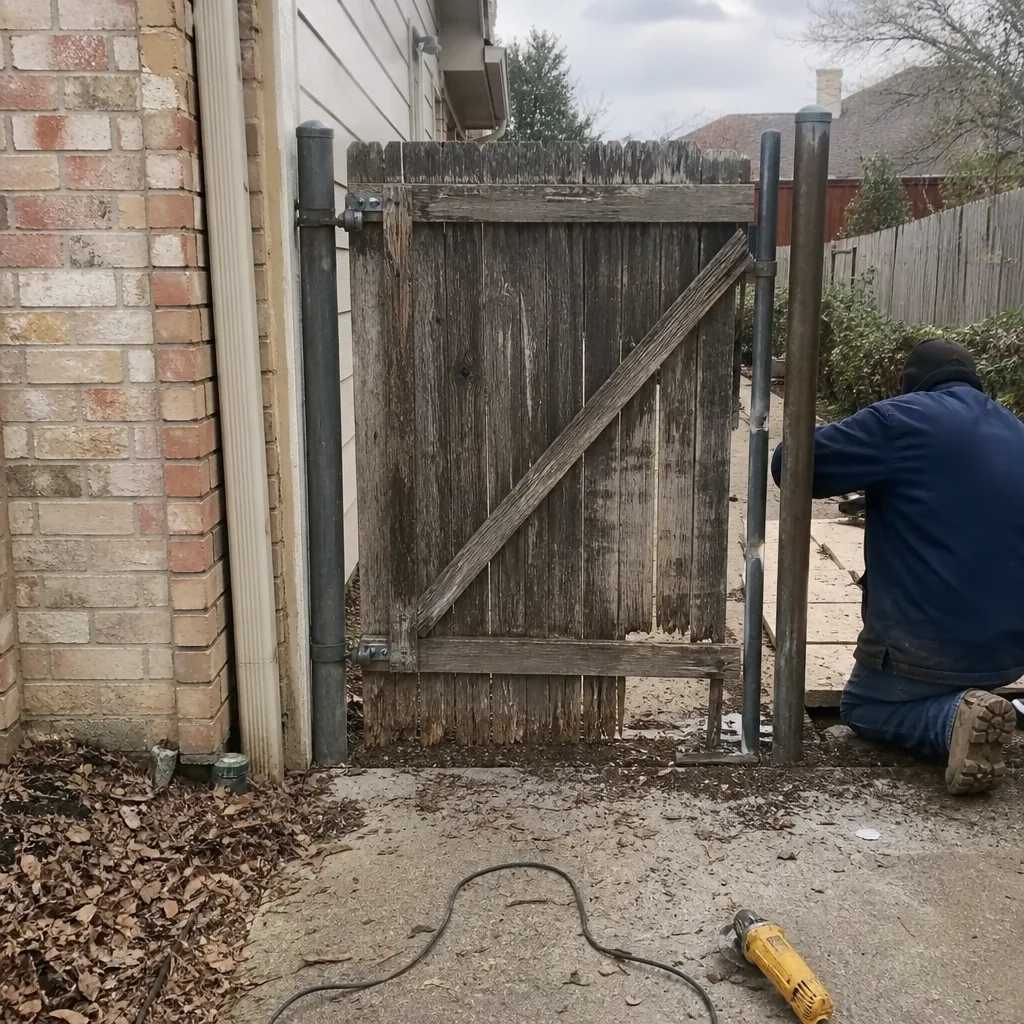 Before
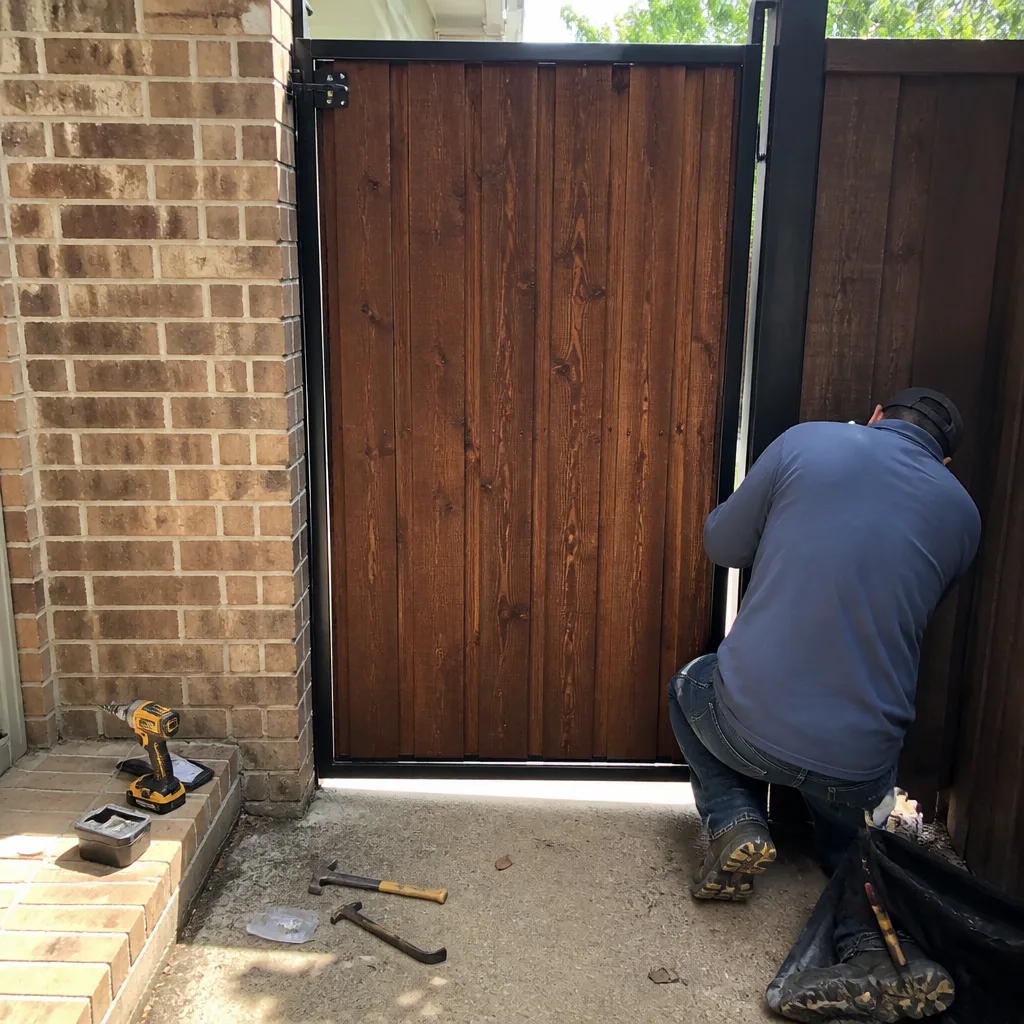 After
After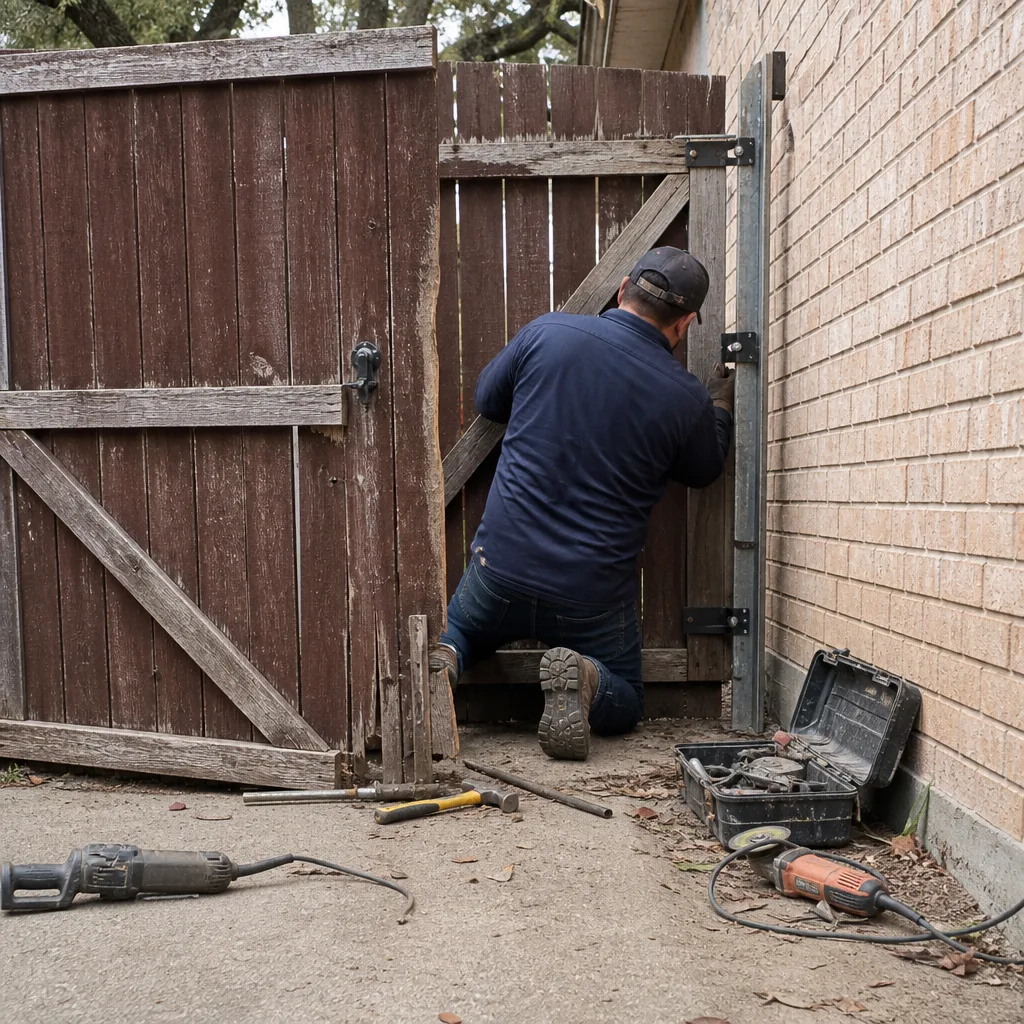 Before
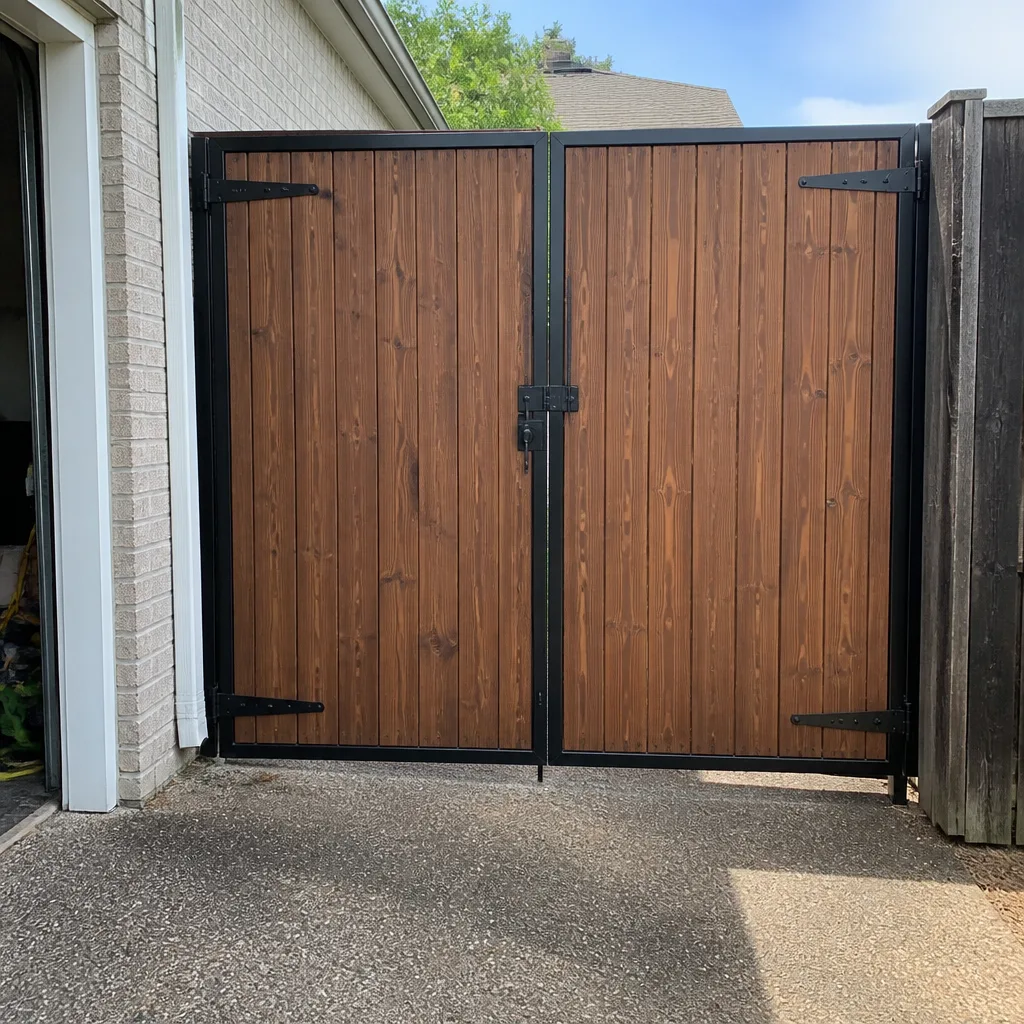 After
AfterGate Repair Warning Signs: A Irving Homeowner’s Reference Guide
A gate that hesitates for half a second on open before moving is already in a late failure stage. That pause is the motor compensating for a mechanical resistance it will eventually stop being able to overcome, and it usually gives you three to six weeks before a full stop. Most Irving homeowners don’t notice the warning signs until the gate refuses to move at all, but the symptoms are there, audible and visible, if you know what to listen for and where to look. This guide names each warning sign, explains the mechanical cause behind it, and gives you an honest timeline for how long you likely have before a nuisance becomes an emergency call. We’ve repaired thousands of gates in Irving since 2014, and the failures that cost the most are almost always the ones that whispered for weeks before they shouted.
Quick Answer
Gate failure in Irving typically announces itself through five sequential warning signs: a clicking sound from the control board, a grinding or scraping noise during travel, a half-second hesitation on start, visible drift from the normal stopping position, and finally partial-cycle stops where the gate reverses or halts mid-travel. A homeowner who catches the first three signs can usually schedule a repair at normal rates. A homeowner who waits for the full stop is almost always looking at a motor replacement, a bent gate frame, or both.
Table of Contents
- The Audible Warning Sequence: Click, Grind, Hesitation, Stop
- How to Measure Gate Drift with Nothing but a Tape Measure
- Irving-Specific Visual Signs: Rust, Clay Soil, and Post Lean
- Electrical Warning Signs You Can Observe Without a Meter
- How to Document a Warning Sign with a Phone Video for Remote Diagnosis
- The Failure Timeline: How Long You Actually Have
- Brand-Specific Warning Patterns: Linear, Viking, Ghost Controls, and DoorKing
- Common Mistakes to Avoid
- When to Call a Professional
- Frequently Asked Questions
- The Bottom Line
BeforeAfterThe Audible Warning Sequence: Click, Grind, Hesitation, Stop
Most residential gate failures follow a predictable sequence of sounds. Understanding what each sound corresponds to, mechanically, lets you know whether you’re dealing with a $75 control board relay or a $1,200 motor replacement. Here’s the sequence as we encounter it on service calls across Irving, from Valley Ranch to Las Colinas to the established neighborhoods around MacArthur High School.
Stage 1: The Click
A single sharp click from the control board when you press the remote, followed by nothing, usually means the relay is firing but the motor isn’t receiving power. This is often a capacitor failure, a loose wire terminal, or a tripped internal breaker. In Irving’s summer heat, capacitor failures are more common than in cooler climates because sustained temperatures above 95 degrees accelerate electrolyte breakdown inside the component. A click that repeats rapidly, three or four times in quick succession, points to a control board that’s trying and failing to communicate with the motor. Fixing this at the click stage typically runs $120 to $260. Waiting until the click stops entirely, which it will, usually means the board has burned out completely.
Stage 2: The Grind
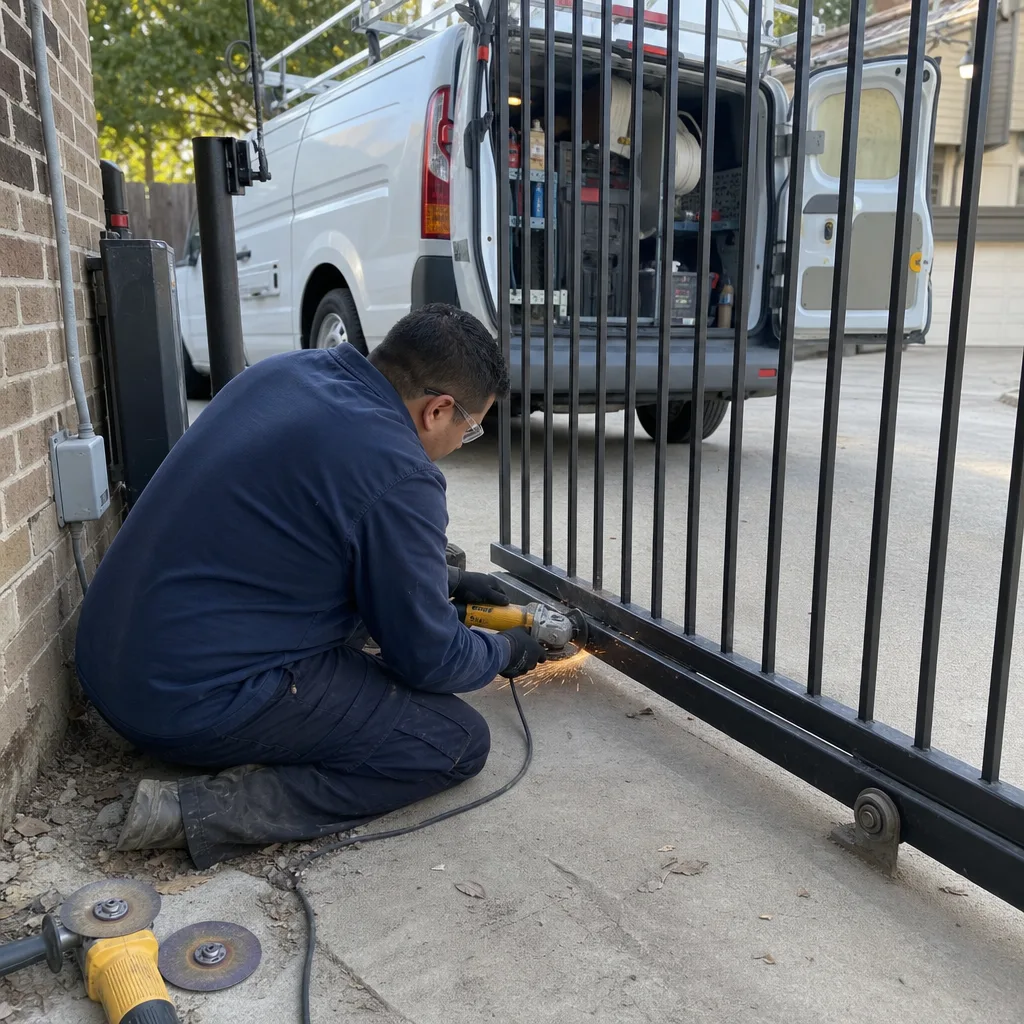
A grinding or scraping noise during gate travel is never normal, and it never resolves itself. On a sliding gate, this sound is usually the drive chain dragging across a worn sprocket or the gate rollers running on bearings that have gone dry. On a swing gate, a grind typically means the arm bracket has loosened and the motor arm is now rubbing against the gate frame. If you hear it, you have days to weeks before the friction causes a component to seize. We’ve replaced gate rollers in Irving where the bearing had worn completely through, leaving the gate rolling directly on the track, cutting a groove into the steel.
Stage 3: The Hesitation
The half-second pause between pressing the remote and the gate beginning to move is the motor straining against resistance. It’s compensating, drawing extra current to overcome whatever is binding. This stage is the last one before mechanical failure, and it’s the one homeowners most often dismiss. What causes the resistance varies: a bent track on a sliding gate, a sagging hinge on a swing gate, a low-voltage condition at the motor. But the outcome is the same. The motor works harder, runs hotter, and eventually burns out a winding or strips a gear.
Stage 4: The Stop
By the time the gate stops moving entirely, the failure has cascaded. What began as a $140 capacitor or a $95 roller replacement has become a motor replacement, often accompanied by secondary damage to the gate frame, the track, or the mounting hardware. In our Irving repair work, the single most common sentence we hear is, “It made a weird noise for a while, and then it just quit.” The weird noise was the warning. The quit was the bill.
How to Measure Gate Drift with Nothing but a Tape Measure
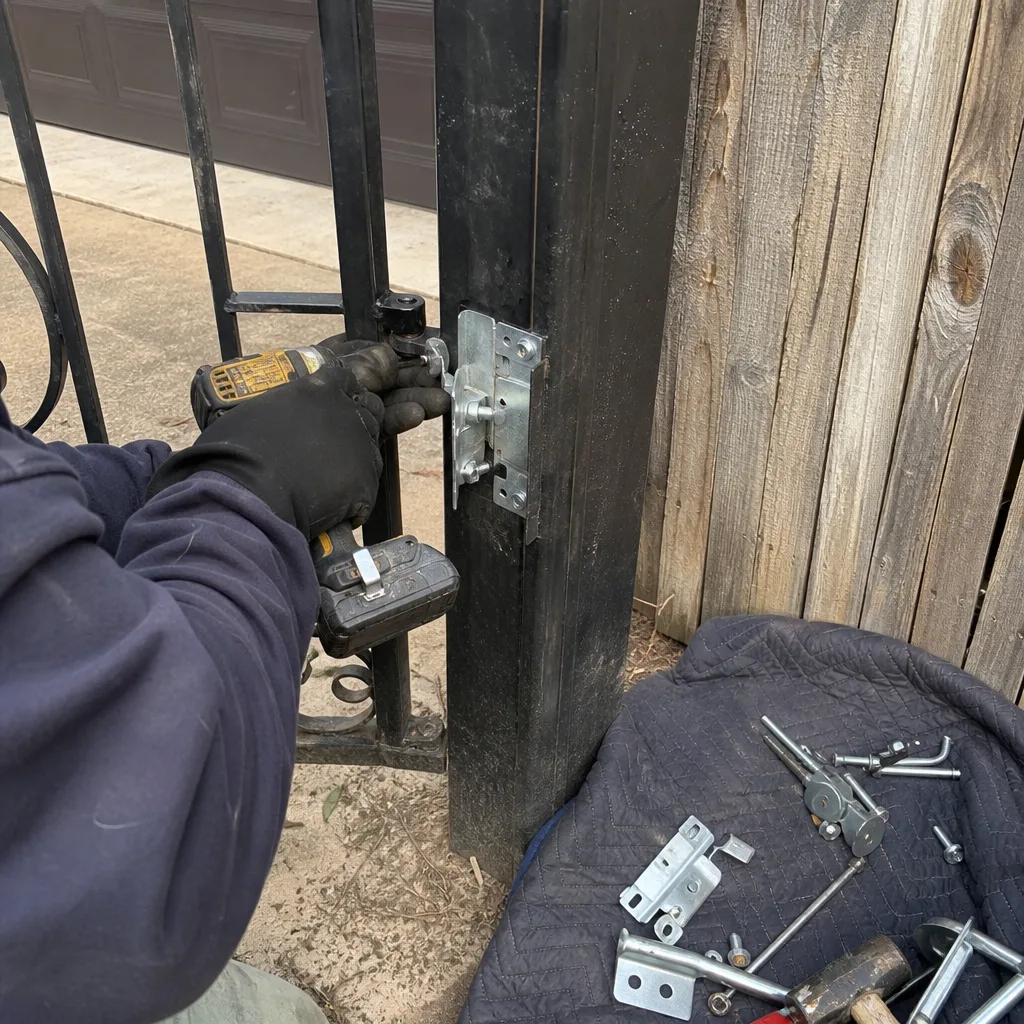
Gate drift is the most underrated early-warning indicator in residential gate maintenance. Drift is the gap between where the gate stops on its own and where it was originally set to stop. It’s measurable, it’s objective, and it tells you something real about the condition of your motor and mechanical components. And you can measure it in about ninety seconds with a tape measure.
- Establish a reference point. Pick a fixed object near the gate’s normal stopping position: a fence post, a column, a line in the concrete. Measure the distance from that reference point to the gate edge when the gate is in its normal closed position. Record that number.
- Run the gate through a full open-close cycle. Let it stop naturally, without an obstruction or a remote override.
- Measure again. If the gate now stops two inches short of where it used to, that’s drift. If it’s four inches off, that’s serious drift.
- Repeat the measurement across a week. Drift that’s stable might be a limit switch that was always set slightly off. Drift that increases, even by half an inch per week, is a mechanical problem getting worse.
What causes drift in Irving specifically? Two things we see more often here than in other markets. First, temperature swings between Irving’s hot afternoons and cooler nights cause metal gates to expand and contract. Over years, that thermal cycling loosens the bolts that hold the limit switch cams in place, and the cams slip slightly. Second, Irving’s clay-heavy soil shifts with moisture content. A post that moves a quarter inch underground translates to an inch or more of drift at the gate’s far edge. If you’re measuring drift and it’s getting worse, the fix is usually mechanical adjustment plus, in many cases, resetting the limit positions. On most residential gates, that’s a $150 to $350 service call, depending on the motor brand and whether the limit switch cams need replacement.
Irving-Specific Visual Signs: Rust, Clay Soil, and Post Lean
Irving’s climate creates a specific set of visual warning signs that you won’t find in a generic gate maintenance guide. The combination of hot, humid summers, occasional ice events, and expansive clay soil produces failure patterns that are distinct to this region.
Rust: When It’s Cosmetic and When It’s Structural
Surface oxidation, the reddish-brown film on the surface of a steel gate, is almost always cosmetic. It looks bad but doesn’t compromise strength. Structural rust is different. Look for rust that flakes in layers, rust that has created visible pitting, or rust concentrated at joints, hinges, and weld points. When rust forms on the underside of a gate frame where water pools, it’s actively thinning the steel. A good test: press a flathead screwdriver against a rusty area with moderate pressure. If the steel flexes or crumbles, you have structural compromise. If it rings solid, you have time. In Irving, gates that face north and get less direct sun hold moisture longer and rust faster. Gates in shaded lots under mature trees, common in older neighborhoods near Heritage Park, show more aggressive rust than gates in full sun.
Clay Soil and Post Lean
Irving sits on the Eagle Ford Shale and expansive clay soils that contract during dry spells and swell after rain. That movement pushes and pulls on gate posts. A post that was perfectly plumb in April can lean two degrees by August. You can detect it before the gate stops working: look at the gap between the gate and the post at the top versus the bottom. If the gap is uneven, the post has moved. On a swing gate, post lean changes the geometry of the hinge arc, which forces the motor to work against gravity on every cycle. On a sliding gate, a leaning post pulls the track out of level, which causes the gate to bind at the far end of travel. Post lean is fixable, usually by re-setting the post in concrete or adding a concrete collar, but it’s a job for someone who works with gates specifically, not a general handyman.
Electrical Warning Signs You Can Observe Without a Meter
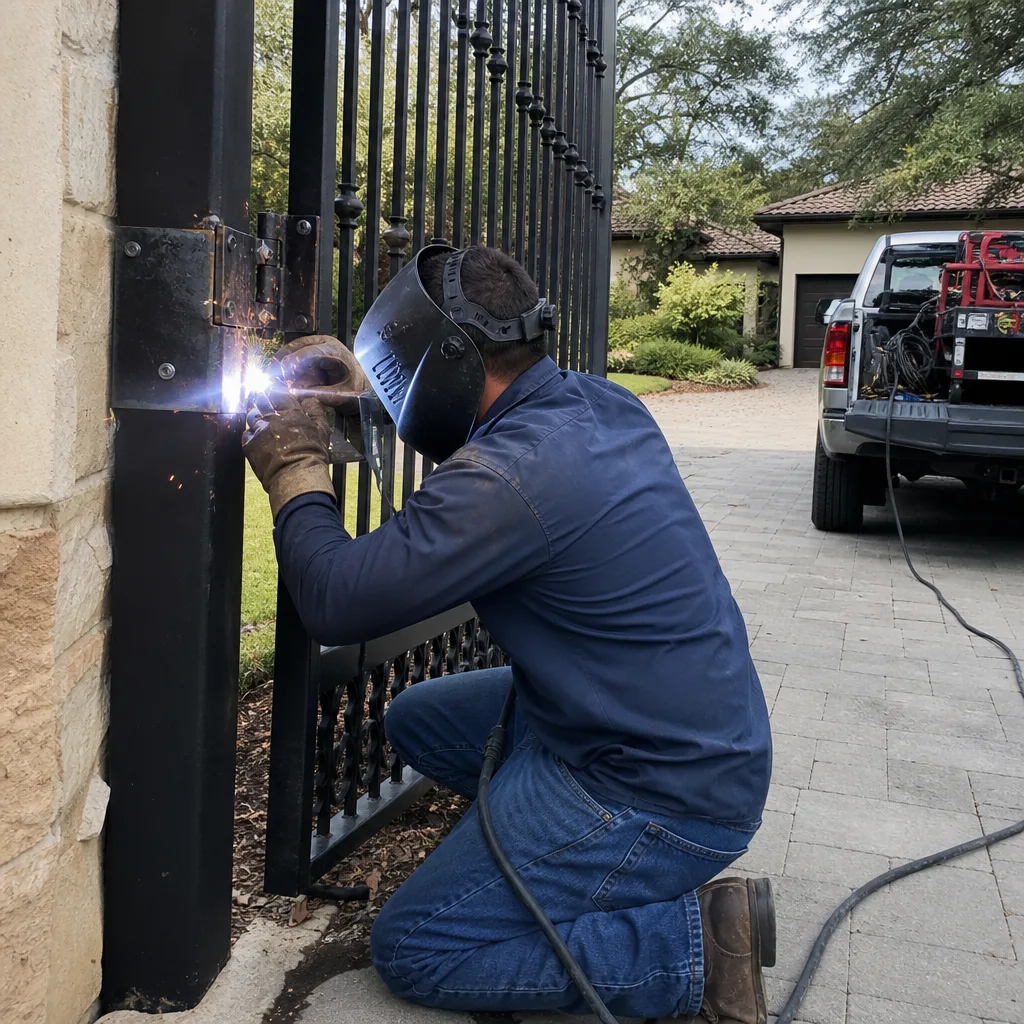
You don’t need a multimeter to catch most electrical warning signs on a residential gate. You need attention and a little patience. Here are the four most common electrical symptoms we diagnose over the phone in Irving, based entirely on what homeowners observe.
- The remote works only from half its normal range. If you used to open the gate from the street and now you have to pull up to the gate before it responds, the receiver board is failing or the antenna has been damaged. Range reduction is often the first sign of a failing receiver, and it typically appears six to twelve weeks before total failure.
- The gate behaves differently at different times of day. A gate that works fine in the morning but struggles or refuses in the afternoon is usually suffering from a voltage drop. In Irving’s summer, the electrical grid carries heavier load in the afternoon, and a gate motor on an undersized circuit or a long wire run will brown out. This is a power supply issue, not a motor issue, and the fix is often a new transformer or a dedicated circuit.
- The gate stops mid-cycle and then resumes after a delay. This is the motor’s thermal overload switch tripping. The motor is overheating, shutting down to cool, and then re-engaging. If you see this behavior, stop running the gate. Every thermal trip shortens the motor’s remaining life. Call for service before the overload stops resetting.
- The gate opens but won’t close, or closes but won’t open. This points to a photo-eye alignment issue, a failed safety edge, or a limit switch that’s stuck in one direction. A photo-eye, the infrared beam that stops the gate if something crosses the path, is misaligned by as little as two inches and the gate will refuse to complete a close cycle. Resetting a photo-eye is a fifteen-minute fix. Ignoring it and forcing the gate closed with the manual release is how gates get bent.
How to Document a Warning Sign with a Phone Video for Remote Diagnosis
A well-shot phone video can save you a diagnostic fee and get a technician to the right fix on the first visit. Most of the videos we receive from Irving homeowners are unusable: shaky footage, no audio context, the wrong angle. Here’s how to shoot a video that a gate technician can actually work from.
- Shoot from the motor side, not the gate side. The technician needs to see the motor arm, the drive chain or belt, and the control board. Stand where you can see how the motor is connected to the gate.
- Capture the sound. Most warning signs are audible. Hold the phone still, don’t talk over the gate, and let the gate run through a full cycle. The audio is often more diagnostic than the video.
- Show the starting position and the ending position. Before you run the gate, film the closed position. Then run it. Then film the open position. Drift is visible in the video if both positions are captured.
- Include the warning label or brand plate. Every motor has a label with the brand, model, and sometimes the date of manufacture. Ten seconds of clear footage of that label tells the technician which manual to reference before they arrive.
- Run the gate twice. Some failures are intermittent. Two cycles on video capture the inconsistency, which is itself a diagnostic data point.
When you send us a video like this, we can usually tell you what’s wrong before we dispatch a technician. That means the technician arrives with the right parts, and you pay for one trip, not two.
The Failure Timeline: How Long You Actually Have
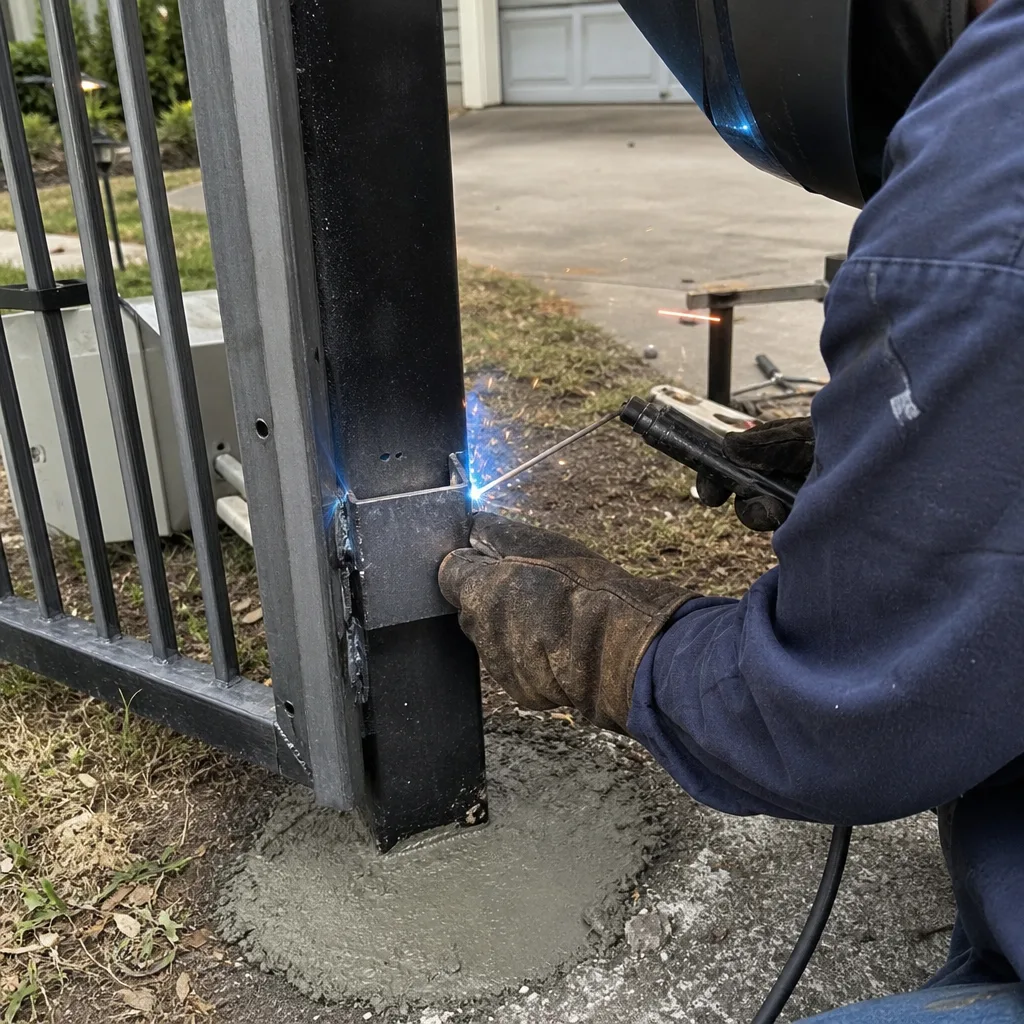
Based on service records from Irving, here’s the realistic timeline from first warning sign to full failure for the most common gate problems. These are averages, not guarantees. A gate that’s heavily used, or a gate on a property with active soil movement, will progress faster.
- Click, no movement: 1 to 4 weeks until total board failure.
- Grinding or scraping during travel: 3 to 14 days until a component seizes or strips.
- Hesitation on start: 3 to 6 weeks until the motor burns out or a gear strips.
- Gate drift, measured at 1-3 inches: 4 to 8 weeks until the gate binds or fails to close fully.
- Remote range reduced by half: 6 to 12 weeks until the receiver fails completely.
- Thermal overload trip, once: 1 to 4 weeks until the motor no longer resets.
- Post lean visible to the eye: Months, but each week the motor works harder, accelerating its wear. The longer you wait, the more parts you replace.
The takeaway: most gate failures give you at least two weeks of warning. The earlier you respond to the warning, the smaller the repair bill. A capacitor replacement at $140, done in week one, never becomes a motor replacement at $900, done in week six.
Brand-Specific Warning Patterns: Linear, Viking, Ghost Controls, and DoorKing
Different gate automation brands fail differently. Knowing what to expect from your specific brand helps you interpret the warning signs. We service nine major brands, but these four account for the majority of residential installations in Irving.
Linear
Linear operators are common on residential swing gates in Irving, and their most frequent failure mode is limit switch drift. Linear uses mechanical limit switches with cam locks, and over time the cams work loose. The symptom is the gate stopping short or over-traveling by a few inches, gradually worsening. A Linear that’s drifting is usually a $150 to $250 adjustment. A Linear that has stopped entirely is usually a $350 to $600 repair.
Viking
Viking operators are built for heavy gates, and they’re reliable, but they’re sensitive to low voltage. A Viking on an undersized circuit will trip its internal breaker or fail to start in the heat of the afternoon. The warning sign is inconsistent starting, especially in summer. The fix is usually electrical, not mechanical: a dedicated circuit, a heavier-gauge wire run, or a replacement transformer.
Ghost Controls
Ghost Controls markets to the DIY installer, and a significant number of Ghost Controls gates in Irving were self-installed. The most common warning sign we see on these systems is gear stripping, which presents as a grinding sound followed by the gate moving freely by hand but not under power. Ghost Controls gear kits are replaceable, but it’s a job that requires removing the arm, and most homeowners prefer to have it done professionally.
DoorKing
DoorKing is the workhorse of the access-control world, and its residential installations in Irving are usually older units from the 2000s. The most common warning sign on an aging DoorKing is capacitor failure, which presents as a click with no movement. DoorKing capacitors are replaceable, and if caught early, the repair is under $200. Ignored, a failed capacitor can take out the control board, which is a $400 to $700 part.
Common Mistakes to Avoid
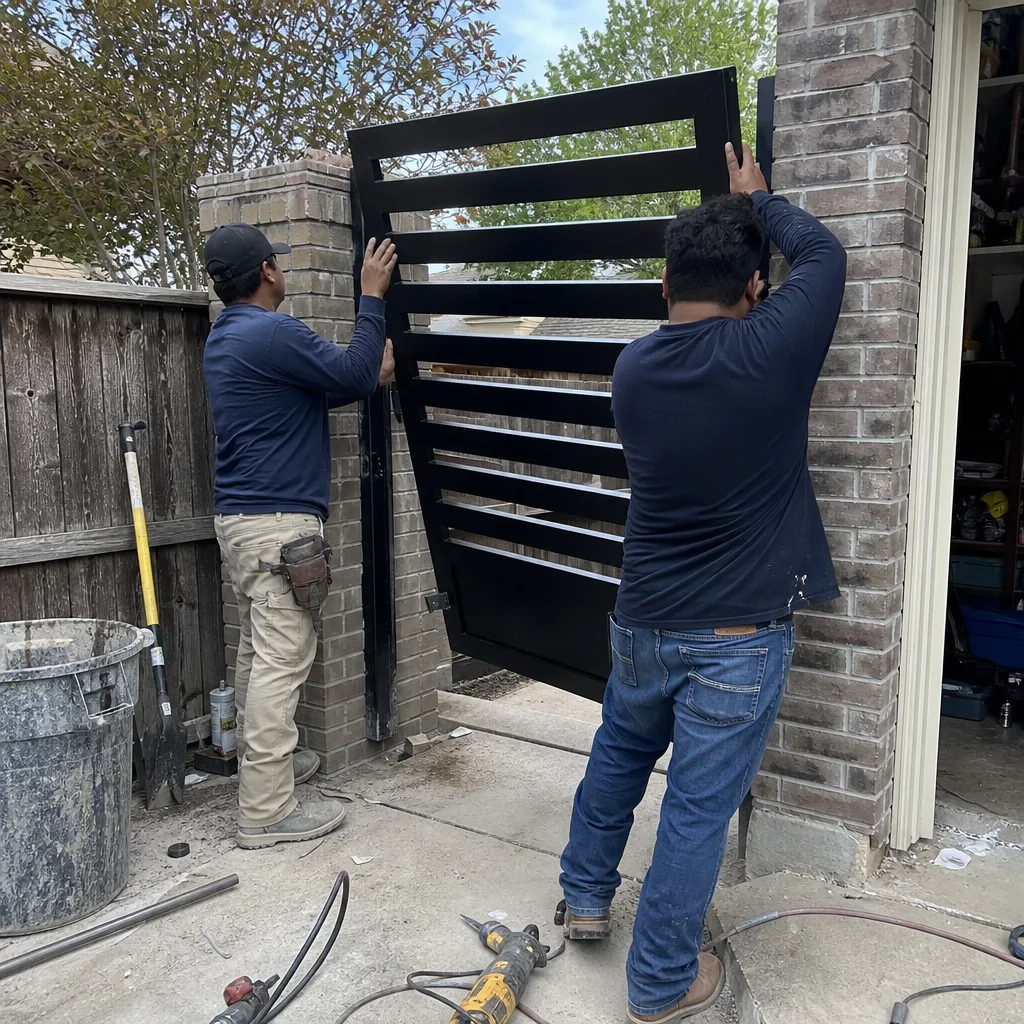
- Ignoring the first click. A single click with no movement is not a fluke. It’s the first audible signal that a component is failing. Every week you ignore it, the repair gets more expensive.
- Forcing the gate manually without releasing the operator. Every automatic gate has a manual release, usually a lever or key on the motor. If you push or pull the gate without disengaging the operator, you can strip the gears. We’ve replaced gearboxes in Irving where the damage was caused entirely by manual forcing.
- Lubricating without cleaning first. Spraying lubricant on a dirty chain or roller just creates a grinding paste that accelerates wear. Clean the component first, then lubricate, or skip the DIY and let a technician do it properly.
- Adjusting the limit switches repeatedly to compensate for drift. If your gate is drifting, resetting the limits without finding the cause is like putting a new battery in a car with a dead alternator. You’re masking the problem, and the underlying issue is getting worse.
- Assuming a rusted gate can’t be saved. Surface rust is cosmetic and repairable. Structural rust at joints is serious but often weldable. Don’t replace a gate before a professional has assessed whether it can be repaired.
- Waiting for the gate to fail completely before calling. The homeowner who calls at the first click pays $140. The homeowner who calls after the full stop pays $900. Same gate, same problem, different timing, different bill.
When to Call a Professional
Call a professional the moment you hear a new sound from your gate, notice it stopping in a different position than it used to, or see the remote range shrink. These are not things that self-correct. A gate operator is a machine with a motor, gears, and electrical components, and like any machine, it fails on a schedule. The skill is in catching the failure before it cascades. If you’ve noticed any of the warning signs in this guide, Gate Repair in Irving is our core service, and we’d rather take your call at the click stage than the stop stage. Vance Gate Repair Irving offers free estimates in Irving, and every job starts with a written price before any work begins. Call (817) 510-4183 and a live person will answer, any hour, any day.
Frequently Asked Questions
Most residential gate repair jobs in Irving fall between $140 and $600, depending on the component and the brand. A capacitor replacement or limit switch adjustment runs $140 to $250. A gear kit replacement runs $300 to $500. A full motor replacement runs $600 to $1,200. The price is quoted in writing before any work starts, and that’s the price you pay. For an exact quote on your gate, call (817) 510-4183 and describe what you’re seeing and hearing.
Yes. A live person answers our phone 24 hours a day, seven days a week, and we dispatch same-day for gate failures in Irving. If your gate is stuck closed and your vehicle is trapped inside, tell the person on the phone and we’ll prioritize the call. We carry common parts for Linear, Viking, Ghost Controls, and DoorKing operators on our trucks.
No. A grinding noise means metal is rubbing against metal under load, and every cycle makes the problem worse. If you must use the gate, use the manual release to disengage the operator and open the gate by hand. Otherwise, leave it in whatever position it’s in and wait for the technician. Running a grinding gate is how a $150 roller replacement becomes a $900 motor replacement.
In most cases, repair is the better value. A well-built steel gate with a functioning operator can last decades with proper maintenance. The factors that push toward replacement are structural rust that has compromised the frame, a post that has shifted so far that re-setting it would cost more than a new installation, or an operator that’s been discontinued with no available parts. We’ll give you an honest assessment, and if replacement is the right call, we’ll say so. If repair is the right call, we’ll fix it. We don’t steer customers toward Gate Installation in Irving unless the existing gate genuinely can’t be saved.
We service nine major gate automation brands, including Linear, Viking, Ghost Controls, DoorKing, LiftMaster, FAAC, BFT, Elite, and Mighty Mule. If your motor is from one of these brands, we can diagnose and repair it. If it’s a brand we don’t service, we’ll tell you that on the phone before you pay for a service call. For Gate Motor & Opener in Irving service, call (817) 510-4183.
Listen. A click with no movement is electrical. A grinding or scraping sound is mechanical. A hesitation before movement can be either, but it’s usually mechanical resistance causing an electrical overdraw. If you’re not sure, record a video of the gate running through a full cycle and we can usually tell you over the phone what you’re dealing with before we send a technician, or check How to Hire a Gate Repair Contractor in Irving: A Step-by-Step Guide to prepare.
The Bottom Line
A gate doesn’t fail without warning. It clicks, it grinds, it hesitates, it drifts, and it stops. Each of those stages corresponds to a specific mechanical or electrical failure, and each stage has a cheaper fix than the one after it. Irving’s climate, with its heat, humidity, and shifting clay soil, accelerates certain failure modes, but it also makes the warning signs more predictable if you know what to look for. The homeowner who acts early pays a fraction of the cost and keeps a gate that lasts for years. The homeowner who waits pays for the cascade. If your gate is telling you something, listen. Then call a professional who will tell you the truth and put the price in writing before any work starts. Call (817) 510-4183 for a free estimate, any time of day or night.
Written by Adrian Vance, Owner at Vance Gate Repair Irving, serving Irving since 2014. Browse our more guides & resources.